
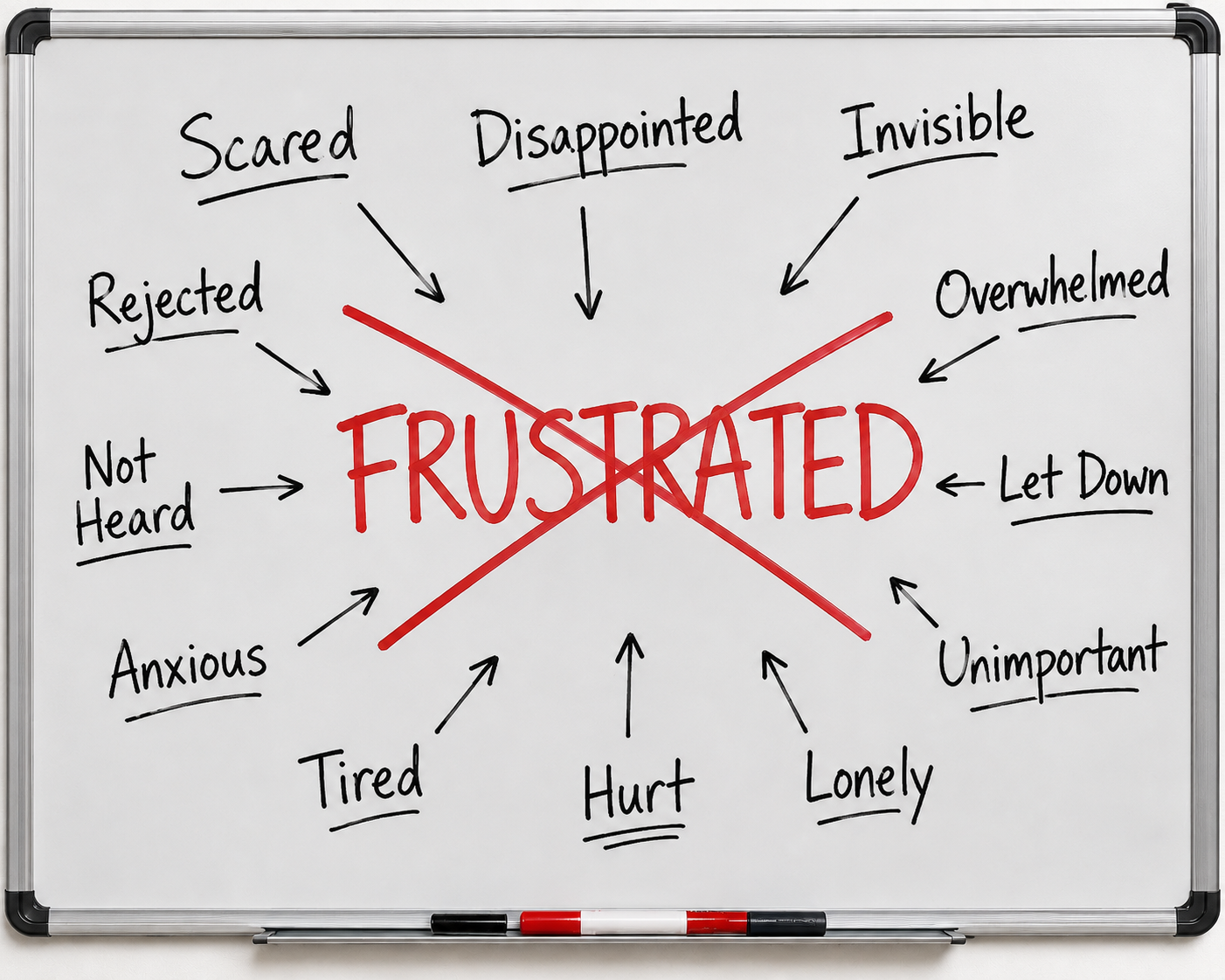
When you get upset is your default response to tell the other person that you’re feeling “frustrated”?
Last week, in one of my therapy sessions the husband (recovering Pleaser) shared with his wife (recovering Vacillator) that he’s confused what she needs from him when she’s upset.
She looked a little incredulous at first, because to her it was obvious. Yet, as we explored deeper and looked at a few different situations of her being frustrated at him, we found that she actually wanted different things each time.
One time, she wanted space.
Another time she wanted him to take the lead.
And yet another time, she wanted him to come after her and initiate a conversation asking why she was upset.
Can you see his confusion?
In therapy, the word “frustrated”—along with its cousins—“annoyed,” “irritated,” and “agitated,” are feeling words I encourage people to exclude from their emotional dictionary.
Why? They are all descriptions of anger. And anger is a secondary emotion—meaning it’s covering for the vulnerable feeling we’re really experiencing.
All negative emotions indicate that we have an emotional need in that moment.
If we feel anxious, we need reassurance.
If we feel rejected, we need acceptance.
If we feel unheard, we need to be heard.
Expressing those emotions tell a very different story than simply saying, “I’m frustrated.”
Because when someone’s angry or frustrated, what they need in that moment is to calm down—but how do you know how to help them do that if you don’t know the primary emotion underneath.
Anger is also a separating emotion—meaning that when someone’s angry, we tend to move away from them rather than toward them.
Think about this, if your spouse says, “I’m frustrated with you,” what are you likely to do? Most people lean away and become defensive because it sounds like an attack is coming.
It’s hard to get your needs met when others are moving away from you.
But what if they said,
“I’m feeling hurt because I don’t feel important to you,” or
“I’m scared that we are growing apart,” or
“I’m disappointed because I was really hoping we would spend time together.”
Suddenly, you have something you can respond to with empathy instead of defensiveness.
One of the reasons many of us default to words like “frustrated” is because we didn’t grow up learning the language of emotions. Likely we grew up with a parent who showed their frustration or no one slowed down long enough to help us identify what was happening inside of us. So, we learned to describe the pressure we felt rather than the vulnerable emotion underneath it.
Secure relationships aren’t built on vague emotional language. They’re built when we learn to recognize what we’re truly feeling and have the courage to express the need beneath that feeling.
The next time you’re tempted to say, “I’m frustrated,” pause for a moment and ask yourself:
“What’s the vulnerable emotion underneath?”
And then ask:
“What’s the emotional need to resolve it?”
Those two questions can completely change the conversation.
Instead of inviting conflict, they invite connection.
Because for emotional connection to happen for us, others need to know the emotion we are wanting them to connect with. It’s hard to respond to an emotion you haven’t identified.
But when you can name your true emotion and request your true need, you give the people who love you the opportunity to understand you, comfort you, and move toward you.
Need Help Identifying and Expressing Your Feelings?
Check out our Comfort Circle FREEBIES!
🎥 Watch a video of Milan and Kay teaching about the Comfort Circle.
💗 Watch Kay guide a couple through the Comfort Circle step-by-step.
📘 Download practical tools — the Comfort Circle Guide for the Listener and the Soul Words (our emotions list) — then try a Comfort Circle together today!
 Thank You for Growing with Us
Thanks for being part of the How We Love community.
Keep learning, keep loving, and keep growing together.
With love and blessings,
Marc & Amy
Milan & Kay
Join over 100,000 people receiving our weekly relationship Insights directly to their Inbox.
Sign up using the form at the bottom of this page.