

Have you ever noticed that when a person uses a “but” right after you’ve shared something, it can feel invalidating?
“I hear you, but…”
“I understand, but…”
“Yeah, but…”
What happens to everything that came before the “but”?
It almost disappears.
Recently, I was having a conversation with someone, and they stopped me and said, “You just ‘yeah-butted’ me.”
It honestly took me a moment to understand what they were saying.
And then I realized—they were right!
They had said something, and I responded, “Yeah, but…” and immediately began explaining my perspective.
I technically acknowledged what they said, but I didn’t really let it land.
When we reply with a “but,” it can feel like a dismissal.
What we often mean is: I heard what you said and now let me explain why I disagree or why my point makes more sense.
And if you’re on the receiving end of a “but…” it can feel quite invalidating.
Now, this one hits close to home for me.
Growing up as the youngest child, I didn’t always feel like my big emotions or opinions were acknowledged because I had the smallest voice in the family. Sometimes, when I expressed what I was feeling, I was laughed at or dismissed rather than validated or approached with curiosity.
And that has subconsciously stuck with me.
So today, I really don’t like it when my wife, Amy, responds to something I say with a “but.”
Yet here’s the humbling part:
As much as I don’t like hearing it, now I’m calling it out in her, I’ve realized I use the word “but” a LOT myself.
Apparently, I’m sensitive to her “buts” and not nearly as aware of my own!
So, I’ve been consciously trying to catch myself.
And it is hard!
Because “but” is so automatic for me—and maybe for you too.
Here’s something I’ve discovered though: most of the time, you don’t even need the word.
You can simply put a period where the “but” would have been.
“I hear you.”
Period.
“I can understand why that hurt.”
Period.
“I can see why you experienced it that way.”
Period.
Let what the other person said land. Then acknowledge their opinion or emotion behind the statement.
“That sounds disappointing.”
Then you can share your perspective in a separate sentence.
“I can understand why you’re hurt. I have a different perspective.”
I can validate someone’s experience and still have needs of my own.
I can acknowledge that I hurt someone and explain what was happening inside of me.
That’s the second thing I’ve been practicing: replacing “but” with “and.”
“I hear you, and…”
“I understand, and…”
“Yes, you might be right, and…”
It’s a small change, but it can completely change how the thought is received.
“But” often feels like subtraction.
“And” can feel like addition.
“But” says, What I’m about to say may cancel out what you just said.
“And” says, There’s room here for your experience and mine.
That’s especially important in relationships because so many of our arguments aren’t really about who has the facts right. They’re about whether we feel heard, understood, and valued.
Sometimes we’re so anxious to explain ourselves that we rush right past understanding the other person.
And when people don’t feel heard, they usually don’t become more receptive to our point of view. They become more determined to make us understand theirs.
That’s usually when the conversation escalates.
Here’s my challenge for you this week:
Pay attention to your “but.”
Notice how often you say it—especially when someone is expressing a feeling, a hurt, or a perspective you don’t agree with.
Before you say, “Yeah, but…” try stopping at “Yeah.”
Put a period there.
Or replace the “but” with an “and.”
You may be surprised how differently the conversation goes.
Because sometimes improving our relationships doesn’t require some enormous breakthrough moment.
Sometimes it starts with changing one little word.
So, slim your “but.”
You’ll live a healthier emotional life and make a whole lot more room for connection!
Do You Know Your Core Pattern?
Your attachment style combined with your partner’s attachment style creates your core pattern.
Every couple will have one until they learn to recognize it and break it.
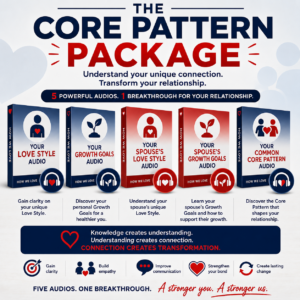
That’s why we’ve created the Core Pattern Package ($30). This walks you through the How We Love journey at a 50% saving.
And if you’re ready for deeper transformation, our Couples Bundle ($149)—includes our best selling couples product our Private Couples Study—and is also customized for your specific core pattern. You’ll receive the full 6-hour How We Love workshop recording, and learn how to apply our healing tool, the Comfort Circle, to build stronger connection all from the comfort of your own home.
With more than 14 hours of content, it’s less than the cost of one hour of therapy!
The 3-Step HWL Journey
Discover your Love Style and understand your relational imprint.
Recognize the Core Patterns created as Love Styles combine in relationships.
Apply our healing tools—the Comfort, Circle and the Growth Goals—to create stronger connections in your relationships.

 Thank You for Growing with Us
Thanks for being part of the How We Love community.
Keep learning, keep loving, and keep growing together.
With love and blessings,
Marc & Amy
Milan & Kay
Join over 100,000 people receiving our weekly relationship Insights directly to their Inbox.
Sign up using the form at the bottom of this page.