People often struggle with two core relational fears: being loved but not truly known or being known but not truly loved.
But here’s the challenge—there are parts of us we openly share, parts we hide, parts others see that we don’t, and parts no one sees at all.
I observed two opposite models from my parents. One parent expressed frustration and pain loudly and openly—even in public—which often drew unwanted and negative attention. The other quietly went inward, carrying on with responsibilities while keeping struggles private.
Wanting to avoid the embarrassment that came with negative attention from sharing loudly, I was conditioned to go inward. And being from England, “keeping calm and carrying on” with responsibilities quietly seemed like the more noble thing to do. Over time, I became someone who handled things quietly, often without others knowing how much distress and emotional pain I was actually carrying.
As a therapist, this creates an internal tension. I spend much of my time encouraging others to open up and be known, yet I can default to handling my own emotional pain alone.
Old associations—like the fear or embarrassment of not having it all together—can quietly steer me toward isolation rather than connection. And yet, I know that staying hidden ultimately hinders growth.
Recently, I’ve begun challenging myself to identify safe, trusted people and let them in. What I’ve experienced in return is empathy, validation, comfort—and most importantly, acceptance and love.
This is where a powerful tool I first learned about in graduate school, the Johari Window, can better help us understand how hiding parts of ourselves limits connection.
What Is the Johari Window
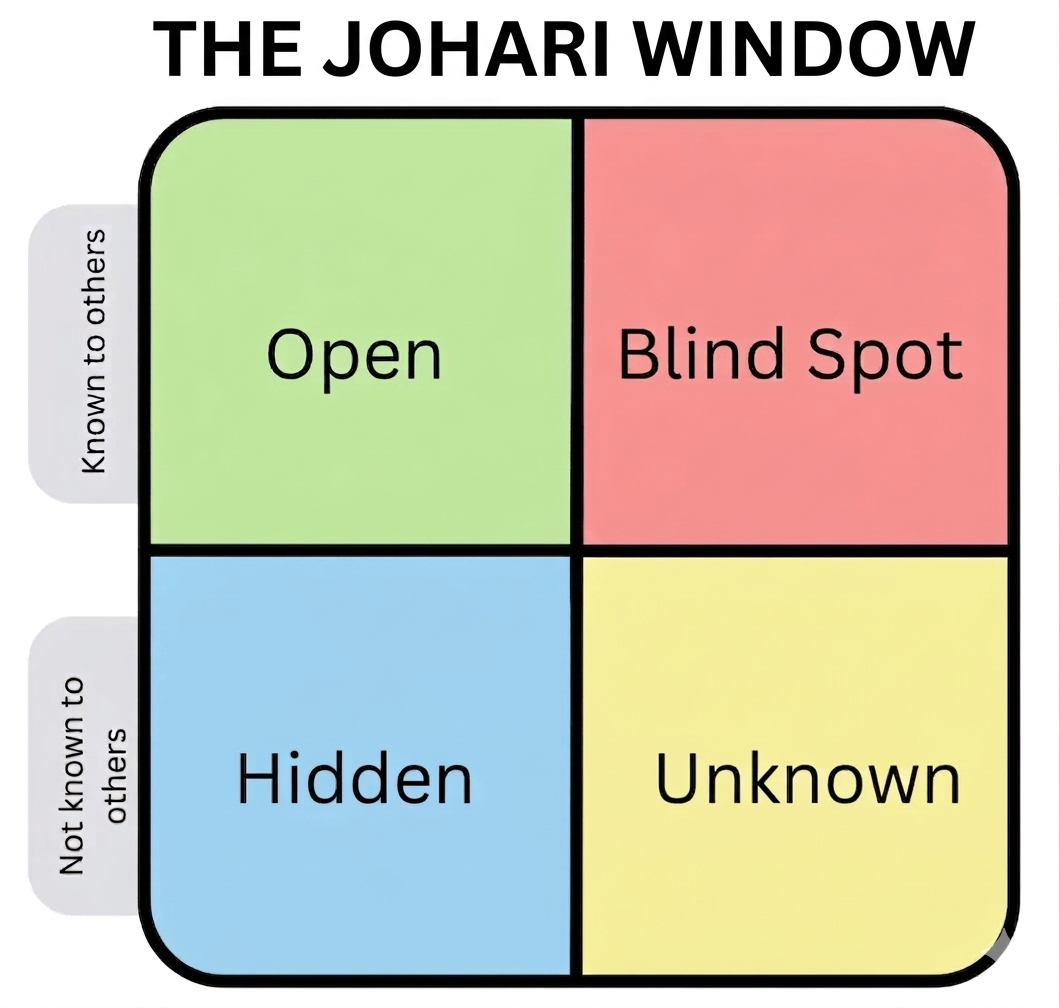
The Johari Window is a simple framework that helps us explore self-awareness and relational connection through four “windows”:
1. Open Area (Known to Self & Others)
This includes what you freely share—your thoughts, feelings, and experiences.Healthy relationships grow when this area expands.
2. Hidden Area (Known to Self, but Hidden from Others)
These are the parts you keep private—fears, struggles, or unmet needs.Vulnerability allows things from this space to become known and move to the Open area, building intimacy.
3. Blind Spot (Unknown to Self, but Known to Others)
These are patterns others can see in you, but you may not recognize.Seeking feedback helps bring awareness , moving things in this space to the Open area for growth to occur.
4. Unknown Area (Unknown to Self & Others)
These are deeper layers—often tied to past wounds or undeveloped parts of yourself.These are uncovered through reflection, counseling, and being in safe relationships.
Why Understanding This Matters
Many people get stuck in painful patterns because they are reacting from places they don’t fully understand.
· A strong reaction might be coming from a hidden fear
· A recurring conflict may be tied to a blind spot
· Emotional distance and isolation grow when we shrink our open area
Growth always begins with awareness and acknowledgment.
When we gain courage to explore these areas, something powerful happens:We move from reacting to understanding
We replace defensiveness with curiosity
We begin to feel seen—and to be truly known
Ready to Begin Being More Fully Known?
Being truly known and fully loved is one of our deepest longings—even if we’re not always aware of it.
But growth doesn’t happen through pressure—it happens through safety.
If you find yourself hiding part of who you are, or if hidden wounds and blind spots feel difficult to discover, the key is to find safe people.
Our webinar, The Safety Pyramid: Finding Safe People can help you discern who is safe to open up to and how to take those steps wisely.
Our Love Style Audios and Growth Goals Audios can help you uncover which parts of yourself you tend to hide and why, while offering practical steps to begin moving toward greater openness and connection.
As you take these steps forward, remember:
· Be kind to yourself
· Be patient with others doing this work
· Move at a pace that feels safe
Healing and connection grow in safe, steady spaces—and at How We Love we’re here to support you.
Thank You for Growing with Us
Thanks for being part of the How We Love community.
Keep learning, keep loving, and keep growing together.
With love and blessings,
Marc & Amy
Milan & Kay